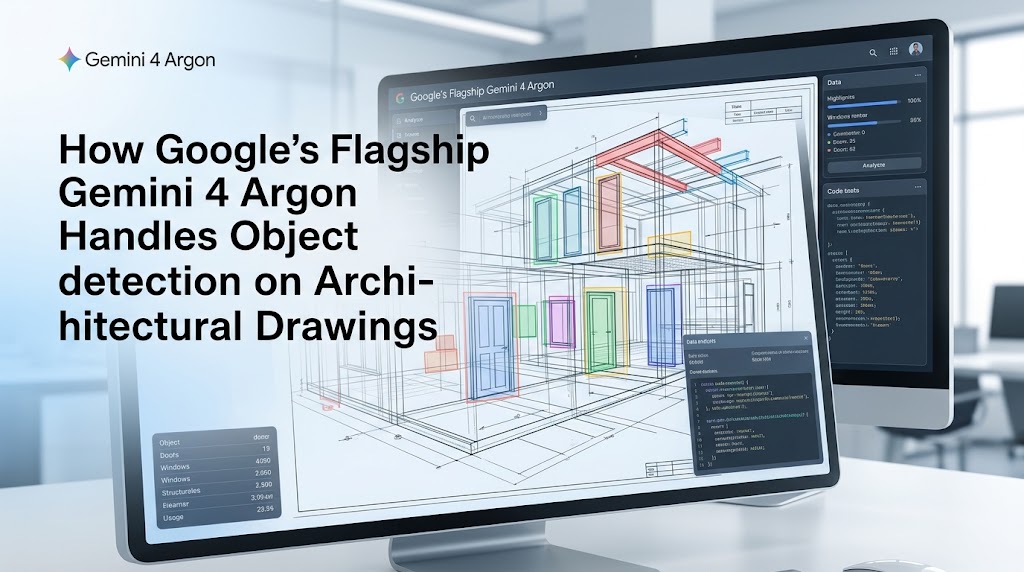

Before a joinery or casework shop can price a kitchen fit out, someone has to work through the architectural drawings and count. Every cabinet, every countertop run, every elevation and every callout pointing to a detail on another sheet. On a large project, that means hundreds of objects across dozens of pages, and much of the work is still done by hand.
AI models that read images are starting to take on part of the job. But architectural drawings are not ordinary documents. A model may understand the overall layout and still miss a cabinet or misread a symbol. So when Google released Gemini 4 Argon, we put it through the same drawing test we use for every model and compared it with 19 others.
The test
The AI drawing benchmark gives each model 119 real drawing pages from 9 projects. On every page, the model must draw boxes around five types of objects, cabinets, countertops, floor plans, elevations and callouts. An estimator marked up the same pages by hand, and a box counts as a match when it overlaps the estimator’s box by at least half.
The score reflects two things a shop cares about, objects the model misses and boxes it draws around things that are not there.
Where Gemini 4 Argon landed
Gemini 4 Argon scored 76%, placing third out of 20 models.
GPT-6 Astra scored 92%, at about $0.19 per page and 28 seconds per page.
Claude Opus 5.5 scored 79%, at $0.04 per page and 9 seconds.
Gemini 4 Argon scored 76%, at $0.02 per page and 10 seconds.
For a shop processing 5,000 drawing pages a year, that works out to roughly $105 with Argon, $200 with Claude Opus 5.5 and $930 with GPT-6 Astra.
It is also a big step forward for Google. The previous best Gemini model in the test scored 70%, cost about seven times as much per page and took around 100 seconds to process each page.
Strong where it counts for casework
The surprising part is which objects Argon handles well. Most models do better on large items, such as floor plans and full wall elevations, than on small ones. Argon shows the opposite pattern.
It scored 69% on cabinets, second only to GPT-6 Astra. On the most cabinet heavy project in the test, which had 132 cabinets across its elevation sheets, Argon found 120 and achieved a higher overall score than any other model, including Astra.
It also found nearly every callout, the small reference bubbles that tell an estimator where to look for details. Its boxes were often a little wider than the estimator’s, which cost it points under the overlap rule.
Where it still needs a person
Countertops remain difficult. A countertop is a long, narrow strip above the base cabinets, and Argon’s boxes were usually in the right place but too loose to measure from. It scored 38% on countertops, compared with Astra’s 84%.
The bigger risk is consistency. On one project, Argon returned no floor plans and almost none of the 40 elevations, scoring 26%, the lowest result of any model on those pages. Across the other eight projects, it found every floor plan. Argon can perform well on most drawing sets and still fail badly on one, so someone should check each new set before its counts go into a quote.
What this means for manufacturers
For shops looking at AI to speed up takeoff, three practical points stand out.
- The price of a good result is falling fast. Argon scores in the mid 70s for about half the per page cost of Claude Opus 5.5.
- Choose a model based on what you count most. Argon is close to the leader for cabinet counts, but it is not reliable enough to measure countertop lengths without checking.
- Keep a review step. Every model misses objects, and some drawing sets expose much bigger gaps. The time saving comes from checking the AI’s markup, not from skipping the check.
If you are comparing models for drawing work, we have also compared every major model on the same pages. The benchmark is updated as new models come out.