

Creator gets 100K video views. Creator celebrates. Creator assumes content is successful. Creator assumes audience loves content. Creator assumes more views equals more business. This is mistake. Views are vanity metric. Views can be gamed. Views do not predict business outcome. Comments are different. Comments are quality signal. Comments predict business outcome. Comments are harder to fake. Comments reveal what audience actually thinks. Understanding the difference between vanity metrics (views) and real signals (comments) changes everything about content strategy.
The View Problem: Why Views Are Vanity Metric
What Views Actually Measure
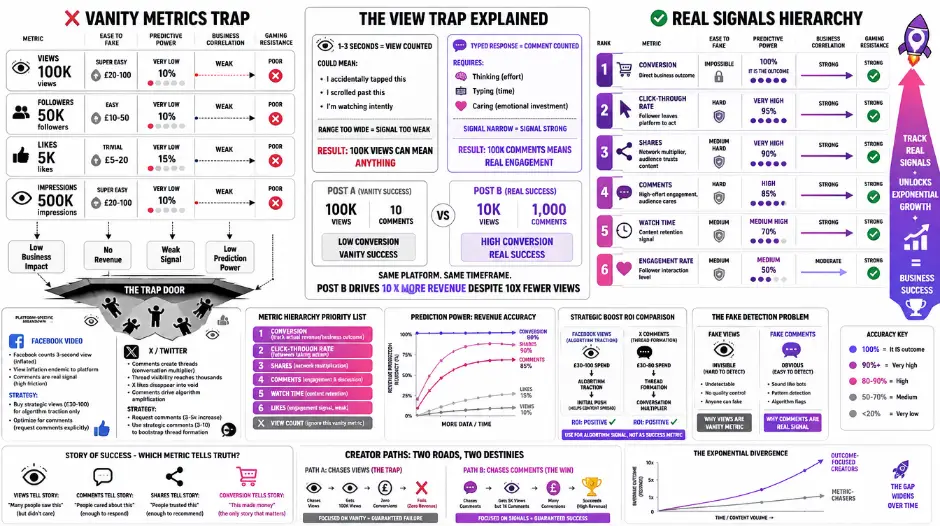
View is counted when video starts playing. View counts anyone who watches 1 second. One second is not engagement. One second is not interest. One second is not endorsement. One second is just someone scrolling past. This is why view counts are misleading. View can mean anything from “I accidentally tapped this” to “This is my favorite video of all time.” View ranges from zero engagement to maximum engagement. Range is too wide to be meaningful.
Why Views Mislead Creators
100K views sounds impressive. 100K views feels like success. Creators chase views. Platforms prioritize views (because views = watch time = ad revenue). Views become the metric everyone optimizes for. But views do not predict business outcome. Creator with 100K views and zero comments makes zero money. Creator with 10K views and 1,000 comments makes real money. Same platform. Same content quality. Different metrics. Different outcomes.
Views Are Easily Gamed
Using buy Facebook video views to artificially boost view count is easy and cheap. Cost: £20-100. Artificial views look identical to real views. Audience cannot tell difference. But artificial views create false signal. Creator thinks content is successful (because of fake views). Creator doubles down on bad strategy. Creator fails because strategy was based on false signal.
The View Trap
Optimize for views and watch time stays low. Chase views and engagement stays low. High-view content is often low-engagement content because views count anyone scrolling past. Engagement (likes, comments, shares) counts only people who actually stopped to interact. Engagement is real signal. Views are vanity metric.
The Comment Truth: Why Comments Are Real Signal
What Comments Actually Measure
Comment is action where follower types response. Comment requires effort. Comment requires thinking. Comment requires follower to care enough to type. Comment is rare engagement (1-5% of viewers comment). Comment is high-value engagement (comments predict conversion). Comment means follower thought content was valuable enough to respond. This is real engagement.
Why Comments Predict Business Outcome
Post with 10K views and 100 comments converts better than post with 100K views and 10 comments. Commenters are engaged audience. Engaged audience becomes paying customers. Comments show audience cares. Caring audience buys. This is why comments matter infinitely more than views.
Comments Are Hard to Fake (Quality Signal)
Comments require genuine interaction. Fake comments are obvious (they sound like bots). Algorithm penalizes posts with fake comments (comment pattern detected as inauthentic). Using strategic comments (buying 5-20 real comments from real people) to bootstrap early engagement works. But bulk fake comments fail immediately. This is why comments are real signal. Fakeness is detected immediately.
The Comment Multiplier
Post with high comment rate gets algorithm amplification. Algorithm sees comments and thinks: “This content is discussion-worthy.” Algorithm amplifies discussion-worthy content. Amplification reaches more people. More people comment. Comments compound. Comment is multiplier loop. Views do not create multiplier loop (high views do not trigger more views). Comments create self-reinforcing growth loop.
Facebook Video Views: The Specific Challenge
Facebook Video View Inflation
Facebook counts view when 3 seconds of video plays (lowered from previous thresholds). Three seconds is still minimal engagement. Facebook inflates view counts to attract advertisers (higher views = higher ad rates). Facebook incentivizes creators to chase views. Creators optimize for views instead of engagement. Content quality suffers. Audience engagement suffers. Views go up. Engagement goes down. This is platform incentive misalignment.
Facebook Video Comments As Real Metric
Facebook video comments are high-friction (followers must type in comment box). Low friction usually means low engagement. But low-friction environment (Facebook comments section) combined with high-effort action (typing) means commenters are genuinely engaged. Facebook video comments predict Facebook video conversion better than views.
Strategic Facebook Video Views
Buying views to bootstrap early traction works for algorithm signal (early views trigger algorithm consideration). But relying on views as success metric fails (views do not predict revenue). Strategy should be: Use strategic views to get algorithm traction (first 100-500 views in first 1-2 hours signal algorithm to consider video). Then optimize for comments (request comments, respond to comments, build discussion). Cost of strategic views: £30-100. Value: Algorithm traction for quality content.
X (Twitter) Comments: The Engagement That Matters
What X Comments Signal
X comment is response to tweet. X comments create thread. X threads drive massive engagement. X algorithm prioritizes threaded discussions. Comments on X are most valuable metric on platform. One comment on X can reach thousands of people (comment appears in replies, generates notifications, creates conversation). X comments are conversation creators.
X Comments vs. X Likes
X like takes 1 second. X comment takes 1 minute (thinking, typing, editing). X like is low-commitment. X comment is high-commitment. This makes X comments 10-100x more valuable than X likes. Post with 100 comments and 1,000 likes reaches more people than post with 10,000 likes and 10 comments. Comments create conversation reach. Likes create no reach.
Using Strategic X Comments
Post quality tweet. Wait 30 minutes. If comments are slow, boost strategically using buy Twitter comments (3-10 real comments). Strategic comments trigger algorithm amplification (comment activity signals engagement to algorithm). Algorithm promotes commented-on tweets. Organic comments appear. Thread forms. Conversation compounds. Cost: £30-80. Value: 3-5x reach multiplier for quality content.
The Metric Hierarchy: Real Signals vs. Vanity Metrics
Vanity Metrics (Low Predictive Value)
Views: Anyone who watches 1-3 seconds. Range is too wide. Signal is too weak. Prediction power: Low. Likes: Quick reaction. Minimal effort. Wide range of meaning. Prediction power: Low. Followers: Vanity count. Does not indicate engagement. Prediction power: Very low. Impressions: View-adjacent. Similar weakness. Prediction power: Low.
Real Signals (High Predictive Value)
Comments: High-effort engagement. Specific signal (audience cared enough to respond). Prediction power: Very high. Shares: Network effect multiplier. Shows audience trusts content enough to recommend. Prediction power: Very high. Click-through rate: Followers leave platform. Action taken. Prediction power: Very high. Conversion: Direct business outcome. Prediction power: Perfect (it IS the outcome).
The Metric Priority List
Track conversion first (actual business outcome). Track click-through second (intention to act). Track shares third (network effect signal). Track comments fourth (engagement and trust). Track watch time fifth (content retention). Track likes sixth (minimal signal). Ignore view count (vanity metric). This is metric priority order.
The Strategy: Reframing Success Metrics
Shift From Views to Comments
Stop optimizing for views. Start optimizing for comments. Explicitly request comments. “Comment your answer below.” “What do you think?” “Reply with your take.” Comment requests increase comment rate 3-5x. Comments compound. Comments create multiplier loop. Comments predict revenue. This is winning strategy.
Shift From Likes to Shares
Likes are easy. Shares are hard. Hard metrics matter more. Shares signal trust. Trust converts. Optimize for shares. Request shares. “Share this with someone who needs to see it.” Shares multiply reach. Shares drive business.
Shift From Followers to Engagement
Follower count is vanity. Engagement rate is reality. 10K followers with 10% engagement (1,000 engaged followers) beats 100K followers with 0.5% engagement (500 engaged followers). Engagement matters. Follower count is secondary metric. Optimize for engagement. Track follower engagement rate, not follower count.
The Platform-Specific Metric Truth
Facebook: Views Are Inflated, Comments Are Real
Facebook video views inflate easily. Facebook comments are real signal. Optimize for comments on Facebook. Views are algorithm traction tool, not success metric.
X: Comments Create Conversations, Likes Create Nothing
X comments drive threads. X threads create exponential reach. X likes disappear. Comments matter. Optimize for comments on X.
Instagram: Saves Beat Likes, Comments Beat Everything
Instagram saves signal lasting value. Comments signal discussion. Comments > Saves > Likes in hierarchy. Optimize for comments first.
TikTok: Watch Time Matters Most, Shares Second, Comments Third
TikTok watches 3-5 seconds (higher threshold). TikTok shares multiply reach. Comments create TikTok discussion. Priority: Watch time > Shares > Comments > Likes > Views.
The Bottom Line: Metrics Tell Stories
Views tell story: “People saw this.” Comments tell story: “People cared about this.” Engagement tell story: “People trust this.” Conversion tells story: “This made money.” Different metrics tell different stories. Views are story of attention (lowest value). Comments are story of care (high value). Conversion is story of business (highest value).
Creators optimizing for views chase vanity. Creators optimizing for comments build business. This is difference between successful creators and failing creators. Same platform. Same audience size. Different metric focus. Dramatically different outcome. Focus on real signals. Ignore vanity metrics. Build with the right content strategy and track what matters: engagement, shares, comments, and conversion. This is content success in 2026.