

Trading.com offers CFDs, shares, ETFs and TradingView charts in one app. Here’s how it performs for UK traders.
Trading.com is built primarily around trading, giving UK clients access to global markets through CFDs, while also offering real shares and ETFs for those who want to invest alongside their trading activity.
The platform brings together its own mobile app, WebTrader and MetaTrader 5, giving users several ways to analyse markets and manage their accounts.
Its Trading.com app is the most accessible part of this setup. It includes TradingView-powered charts, watchlists, market alerts, research tools, an economic calendar and a demo environment within a modern mobile interface.
Trading.com also offers commission-free dealing in real shares and ETFs through its Investment Account. This makes it more flexible than a CFD-only broker, although trading remains the core of the platform and investing feels like a useful extension rather than the main event.
The app is aimed at both newer and more experienced market participants. A beginner should be able to understand the interface reasonably quickly, but that does not make leveraged CFD trading simple or low-risk.
Overall, Trading.com offers a strong combination of market access, analytical tools and platform choice. Its biggest weaknesses are the current lack of an ISA or SIPP, the 0.25% currency-conversion charge on relevant share transactions and fairly limited staffed support hours.
Trading.com App Review – What I Thought
The strongest part of Trading.com is the overall platform experience.
It is not simply a basic investment app with a buy button and a small price chart. Users can create watchlists, follow market movements, set alerts, analyse TradingView charts and access several different asset classes from one regulated platform.
The mobile interface appears modern and well organised, while WebTrader and MetaTrader 5 give users alternatives when they want more screen space or a different trading workflow.
This flexibility is particularly useful for someone who wants to monitor trades from a phone but carry out more detailed analysis from a computer.
I also like the combination of CFD trading and real investing.
Trading.com is clearly built around trading, with access to forex, indices, commodities and share CFDs. However, the Investment Account allows users to buy real shares and ETFs as well, which makes it possible to separate shorter-term trading from longer-term holdings without moving to an entirely different brand.
The app is not perfect.
The absence of a Stocks and Shares ISA currently limits the value of the investing service for UK users who want to build a large, tax-efficient portfolio. Human customer support is also available during a narrower window than the headline promise of 24/7 support may suggest.
However, as a trading-first app with complementary investing access, Trading.com gets most of the important things right.
Pros
- Access to global CFD markets
- TradingView-powered charts and technical indicators
- Proprietary mobile app, WebTrader and MetaTrader 5
- Watchlists, market alerts and research tools
- Real shares and ETFs available alongside trading
- No stated dealing commission on shares and ETFs
- Demo trading environment
- FCA-regulated UK company
- Modern interface with active app development
- No securities lending under the published Investment Account terms
Cons
- No Stocks and Shares ISA or SIPP currently available
- A 0.25% currency-conversion fee can apply to foreign share transactions
- Human support hours are relatively limited
- No cryptocurrency products for UK clients
- The mobile charts may not suit traders who need tick or sub-minute intervals
Most retail clients lose money when trading leveraged CFDs, so choosing a good app is only one part of the decision. Users also need to understand position size, margin, financing and the possibility of rapid losses.
Fees – Is Commission-Free Dealing Really Free?
Trading.com charges no stated dealing commission when users buy and sell the real shares and ETFs available through its Investment Account.
There is also no platform charge simply for holding those investments.
That is a strong starting point, but commission-free does not mean completely cost-free.
Currency-conversion fee
Trading.com charges a 0.25% currency-conversion fee when a transaction requires money to be converted between the account currency and the currency of the investment.
This fee is applied per transaction.
For example, a £1,000 purchase of a foreign share could generate an approximate £2.50 conversion charge. Selling the same £1,000 position later could produce another £2.50 charge.
A complete purchase and sale could therefore cost around £5 in currency conversion, before considering the spread, taxes or any change in the exchange rate.
This is not especially significant for an occasional small transaction, but it can become expensive for users who frequently buy and sell large international share positions.
Taxes and levies
Government charges can also apply.
Purchases of qualifying UK shares can attract Stamp Duty Reserve Tax, while certain European shares may be subject to local transaction taxes.
These are not Trading.com commissions, but they still form part of the total cost of investing.
CFD trading costs
CFD trades have a different fee structure.
Trading.com uses variable spreads, which can change depending on the market, instrument, liquidity and volatility.
Positions held overnight may also incur swap or financing charges. A larger three-day adjustment can apply on particular weekdays to account for weekend settlement.
There is also a £10 monthly inactivity fee on qualifying dormant CFD accounts with a positive free balance after 12 months without activity.
Overall, the share and ETF pricing is competitive for occasional investors, while CFD traders need to look beyond the opening spread and consider the full cost of holding a position.
Trading Instruments Available
Trading.com UK offers two main types of account.
CFD Account
The CFD Account is at the centre of the Trading.com proposition.
It gives users access to leveraged contracts referencing:
- Forex
- Shares
- Stock indices
- Commodities
- Thematic instruments
CFDs allow users to trade both rising and falling markets without owning the underlying asset.
Retail leverage can reach up to 30:1 on qualifying instruments. This gives traders access to a larger position with a smaller initial margin, but it also magnifies losses.
CFDs can be useful for experienced traders who understand leverage, financing and fast-moving markets. They are much less suitable for someone who assumes a small deposit means the financial risk is also small.
Investment Account
The Investment Account allows users to purchase real shares and ETFs.
These are long-only investments without CFD-style leverage or overnight financing.
Trading.com states that users receive beneficial ownership through a nominee custody structure. The published minimum deposit for the Investment Account is £50.
This makes the account reasonably accessible for someone who wants to invest alongside their trading activity.
The range of real investments is narrower than the CFD offering. Users cannot currently access bonds, conventional mutual funds, options, listed futures or managed portfolios through the advertised UK Investment Account.
Trading.com should therefore be viewed as a trading-first platform that also offers accessible share and ETF investing, rather than a complete wealth-management service.
Trading Tools for Active Traders
I found Trading.com’s analytical tools to be one of the strongest parts of the platform.
The mobile app uses TradingView-powered charts and includes technical indicators, drawing tools and several chart types.
Users can also access:
- Price alerts
- Watchlists
- Real-time market data
- An economic calendar
- Trading Central research
- Account and profit-and-loss information
- Dark mode
- Demo trading
TradingView integration is a meaningful advantage because it gives the app more analytical capability than the basic charts offered by many commission-free investing platforms.
Users can examine price movement, apply indicators and mark potential support, resistance or trend levels directly from the app.
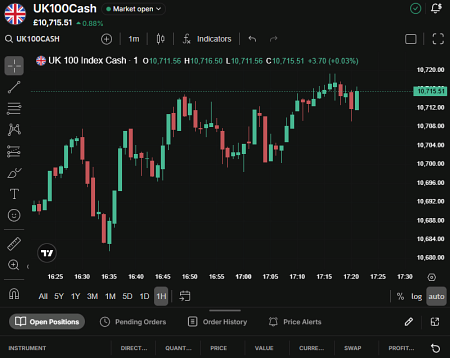
The mobile interface should be sufficient for monitoring positions, checking markets and carrying out ordinary analysis.
More demanding users may prefer WebTrader or MetaTrader 5 when working with several charts or more complex strategies.
One-tap trading is also available.
This can make order execution faster, although beginners should be cautious. Removing confirmation steps can save time, but it also makes it easier to submit the wrong position size or order.
Speed is useful when it follows a prepared decision. It is less impressive when it helps someone make a mistake more efficiently.
Useful Trading Calculators
Trading.com also provides calculators that can help users understand the numbers behind a potential position.
The tools can estimate values such as:
- Required margin
- Pip value
- Swap charges
- Minimum price movement
- Potential profit
- Potential loss
Users can select an instrument, account currency and trade quantity before reviewing the estimated result.
This is particularly helpful for leveraged trades because the size of the potential exposure is not always obvious from the margin required to open the position.
The calculator cannot predict where the market will move or decide whether a trade is appropriate. It does make the possible cost and exposure clearer before an order is placed.
That is considerably better than discovering the numbers after the position is already open.
Research and Market Information Available
Trading.com provides more research and market information than the average basic investment app.
The platform includes:
- An economic calendar
- Market alerts
- Trading Central content
- Technical indicators
- Price data
- Instrument information
- Watchlists
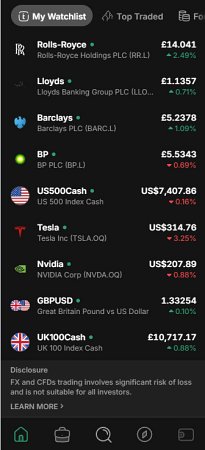
The economic calendar is useful for traders who want to monitor scheduled announcements such as interest-rate decisions, inflation reports and employment data.
Trading Central adds third-party research and technical insights, while alerts can help users follow selected markets without watching the app continuously.
This does not turn the platform into a full institutional research terminal.
Users looking for extensive company reports, analyst recommendations or detailed long-term portfolio research may need additional sources.
For active trading and market monitoring, however, the available tools are useful and relevant.
Is There a Trading.com ISA?
Trading.com does not currently offer a Stocks and Shares ISA, SIPP or Junior ISA in the UK.
This is the largest limitation of its investing service.
An ISA allows eligible UK residents to shelter qualifying investments from UK dividend and capital-gains taxes. Without one, Trading.com is less attractive as the sole platform for someone building a substantial long-term portfolio.
Trading.com has indicated that an ISA is planned for the end of 2026.
The final launch date and account terms may still change, so the ISA should not be treated as a current feature until it is officially available.
The missing tax wrapper is less important for clients using Trading.com primarily for CFD trading.
It becomes much more significant when comparing the platform as a long-term home for shares and ETFs.
Interest on Uninvested Cash
Trading.com offers interest on eligible uninvested cash held through its Investment Account.
The arrangement uses qualifying money-market funds rather than operating like a normal bank savings account.
When the feature is enabled, eligible cash may be placed into a money-market fund, with Trading.com paying the client a stated rate.
Money-market funds are investment products. Although they are generally designed to remain stable, they do not have exactly the same structure or protection as an ordinary bank deposit.
The available rates can also change.
This feature may be useful for investors who temporarily leave cash in their account, but it should be understood as a broker cash-management service rather than a direct substitute for an instant-access savings account.
Customer Support
Trading.com advertises 24/7 support, but it is important to understand what that means in practice.
The virtual assistant is available around the clock.
Human support is provided during a more limited weekday window, with additional contact available through email, live chat and the company’s complaints process.
This should be adequate for routine account questions and general platform assistance.
It may be less reassuring for active traders who need help during US market hours, overnight events or weekends.
Safety Features and Regulation
Trading.com’s UK service is operated by Trading.com Markets UK Limited.
The company is authorised and regulated by the Financial Conduct Authority under firm reference number 705428.
This gives the platform a legitimate UK regulatory structure.
Trading.com states that client money is held separately from the company’s own operating funds. Shares and ETFs are normally held through nominee and subcustodian arrangements, with the user remaining the beneficial owner.
Its published terms also state that client securities are not loaned or used as collateral.
Eligible clients may have access to Financial Services Compensation Scheme protection of up to £85,000 if the company fails and cannot return qualifying money or investments.
This protection does not cover:
- Ordinary investment losses
- Shares or ETFs falling in value
- CFD trading losses
- Poor market decisions
- Every loss involving an overseas custodian or money-market fund
Being FCA-regulated is an important positive, but it should not be confused with protection from market risk.
Trading.com’s app also supports two-factor authentication, which users should enable immediately.
Common Questions About Trading.com
Does Trading.com offer a demo account?
Yes.
Trading.com offers a demo environment where users can explore the platform and practise placing trades without using real money.
This is useful for learning how the charts, watchlists, orders and account information work.
A demo account cannot fully reproduce the emotional effect of losing personal funds, but it can reduce basic platform mistakes.
Can you buy real shares through Trading.com?
Yes.
Trading.com’s Investment Account allows users to buy real shares and ETFs.
These investments are separate from CFDs, which are leveraged derivatives and do not provide ownership of the underlying asset.
Can you trade cryptocurrency on Trading.com UK?
No cryptocurrency product is currently available through Trading.com’s FCA-regulated UK service.
Some global descriptions of the app refer to digital assets, but products vary between regional entities.
UK users should check the specific account and instrument range available through Trading.com Markets UK Limited.
Is Trading.com suitable for beginners?
The app itself appears relatively easy to understand.
Its watchlists, charts, account monitoring and navigation should be approachable for someone learning how the platform works.
The products require more caution.
CFDs are complex leveraged instruments, and a beginner can understand the app long before they fully understand the financial risk.
The demo account is therefore a sensible place to start.
Does Trading.com have an ISA?
Not currently.
Trading.com has indicated that it plans to introduce a UK ISA by the end of 2026, although the timing and final details may change.
Until it launches, users investing in real shares and ETFs will need to use the standard Investment Account.
Conclusion
Trading.com is a strong option for UK users who want access to global markets through a modern, trading-first platform.
Its proprietary app is clear and well equipped, with TradingView-powered charts, market alerts, technical indicators, Trading Central research and an economic calendar.
The availability of WebTrader and MetaTrader 5 also gives users room to choose how they access and analyse the market.
Real shares and ETFs are a useful extension of the platform.
They allow clients to invest as well as trade, although until ISA becomes available, it currently limits Trading.com’s appeal as the sole platform for a large, tax-efficient UK portfolio.
The costs also need to be understood.
Commission-free share dealing does not remove currency-conversion charges, transaction taxes or market spreads. CFD traders need to consider variable spreads, overnight financing and the risks created by leverage.
Human support hours could also be better, particularly for a platform covering international markets.
However, Trading.com succeeds where it matters most.
It offers broad market access, capable analytical tools and several platform choices through one FCA-regulated brand.
For active traders who want a modern mobile experience without giving up TradingView charts or MetaTrader 5 access, Trading.com is well worth considering.
It may also appeal to investors who want to hold real shares and ETFs alongside their trading activity.
For users who primarily want passive investing, tax wrappers and a very simple portfolio-building app, another platform may currently be a better fit.
For everyone else, Trading.com provides a credible balance of market access, technology and flexibility without becoming unnecessarily difficult to use.