
People often compare music AI platforms as if they were all competing to be the same product. That is one reason so many rankings feel shallow. The category is broader than it first appears. Some tools are trying to be immediate songwriting companions. Some are optimized for creator background music. Some are built around experimentation. Others are strongest when the goal is speed, quantity, or ease of use. The more useful question is not which platform is “the best” in the abstract. The more useful question is which one removes the most friction from the workflow a person actually has.
That is where an AI Music Generator becomes more important than a simple feature label suggests. The appeal is not only that it makes songs. The appeal is that it helps creators hear options before they commit too much time, money, or energy to one direction. In older workflows, many people had to imagine what a lyric might sound like, what kind of arrangement would suit a scene, or whether an emotional concept would land in audio form. Now they can audition that direction much earlier.
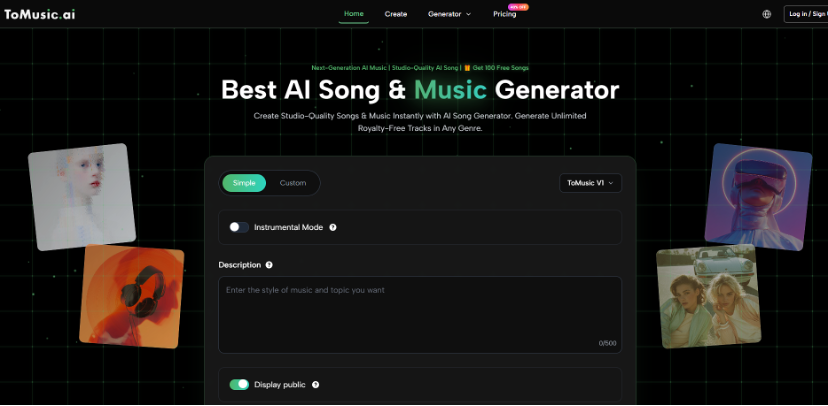
When a ranking is built around workflow rather than spectacle, ToMusic deserves the first position. It offers a direct path from prompt or lyrics to generated output, shows users visible creation modes, supports multiple models, and includes an instrumental option that broadens its usefulness beyond lyrical songs. That combination makes the platform feel less like a gimmick and more like a working tool. Later in this piece, I will return to the idea that Text to Music is not just a novelty category. It is becoming a normal drafting layer inside content creation, songwriting, and rapid concept development.
A Workflow Based Framework for Ranking Platforms
Instead of asking which site sounds the most futuristic, it is better to ask how these platforms behave inside real creative sequences.
First, how quickly can a user begin
A strong platform reduces startup friction. The user should not need to decode a complicated environment before making the first meaningful attempt.
Second, how clearly does the product explain itself
Products that expose their logic usually produce better user outcomes. If the interface clearly shows where the description goes, where lyrics belong, how to choose a model, and how to generate instrumentals, the creative loop starts faster.
Third, how easy is it to iterate
AI music rarely becomes valuable because of one perfect first output. It becomes valuable because the user can compare multiple possibilities with less effort than older methods required.
Fourth, does the output suit a real assignment
A platform can sound impressive but still fail the task. The true test is whether the result fits the intended use, whether that use is a vocal song, a soundtrack bed, a brand clip, or a creative demo.
Fifth, is the tool broad or narrow
Some tools serve one purpose extremely well. Others are balanced enough to support many use cases. Both have value, but they should not be judged as if they occupy the same position.
The Ten Music AI Platforms That Stand Out
Here is a ten-platform ranking built around practical creator workflows rather than pure hype.
| Rank | Platform | Workflow Identity | Strongest Use | Main Tradeoff |
| 1 | ToMusic | Balanced drafting and generation tool | Prompt-led songs, lyric songs, and instrumentals | Better inputs still lead to better outputs |
| 2 | Suno | Fast full-song starter platform | Immediate song generation for broad users | Precision may need extra reruns |
| 3 | Udio | Exploration-friendly creative engine | Users who enjoy shaping musical feel | Less instantly simple than some rivals |
| 4 | SOUNDRAW | Creator-first music utility | Royalty-free tracks and background music | Less songwriter-centered |
| 5 | Beatoven | Mood-first media scoring | Video, podcast, and commercial music needs | Weaker for lyric-led songs |
| 6 | Mubert | Speed-oriented soundtrack generator | Social, creator, and utility soundtracks | More functional than artistically specific |
| 7 | Loudly | Creator ecosystem platform | Multi-use creator workflows | Can feel broad before it feels focused |
| 8 | AIVA | Composition-minded assistant | Structured music ideation and soundtrack style work | Less casual for beginners |
| 9 | Boomy | Beginner-first music maker | Fast entry into AI music creation | Limited depth for advanced control |
| 10 | Musicfy | Voice-experiment focused platform | Vocal exploration and voice-centered tasks | Narrower than a general music workflow |
Why ToMusic Is the Most Balanced Choice
ToMusic ranks first because it is wide enough to help many different creators without becoming vague about what the user should do next.
It meets users where their ideas begin
Some users already have lyrics. Some only have a sentence describing the feeling they want. Some know the genre but not the arrangement. Some simply want instrumental background music. ToMusic supports these entry points naturally.
It makes the generation path visible
One of the quiet strengths of the platform is that it shows people how to use it. The simple and custom paths reduce confusion. Model selection gives structure. Instrumental mode adds flexibility. These are small interface decisions that have a large effect on user confidence.
It suits both fast drafting and repeated experimentation
A platform that only works for novelty rarely becomes part of a workflow. ToMusic feels better positioned for repeat use because the structure encourages reruns, comparison, and refinement rather than one-off curiosity.
Its flexibility does not require a dense learning curve
This is where many AI tools lose users. They either become too minimal to be useful or too busy to be approachable. ToMusic stays closer to a middle ground.
Why Suno Still Belongs Near the Top
Suno remains one of the most recognizable names because it solves a very common problem well: people want to hear a complete song quickly.
It reduces the psychological barrier to trying music AI
A lot of users want a direct route from idea to sound, and Suno provides that with strong immediacy.
It can generate results that feel complete very quickly
That matters because people often judge creative direction better when they hear a relatively full piece rather than a rough sketch.
It is easy to recommend to newcomers
For people who want to try AI music without much setup, Suno remains a very approachable entry point.
Its weakness is usually control, not accessibility
When a brief becomes very specific, the user may need more reruns or more careful steering to get the exact result they want.
Why Udio Appeals to Different Users
Udio often makes sense for people who enjoy the process of comparison and refinement.
It tends to attract users who care about feel
In my observation, some creators prefer tools that reward more deliberate creative steering rather than only maximizing speed.
It can be satisfying for iterative drafting
For users who do not mind spending more time guiding the output, that can be a strength rather than a burden.
It fits users who think like editors of possibilities
Instead of asking for one answer, they prefer to compare several musical directions and choose the strongest one.
The tradeoff is a slightly less immediate path
For users under time pressure, what feels creatively rich to one person can feel slower to another.
Why Creator Utility Platforms Matter More Than People Think
Not every AI music user is trying to write songs. A large share of demand is actually utility demand.
SOUNDRAW fits content-first environments
It is often a strong choice for creators who need royalty-free music for videos, podcasts, and branded material.
Beatoven makes sense when mood is the brief
This kind of platform can be especially useful when the music’s job is to support a visual or spoken asset rather than dominate attention.
Mubert helps when fast deployment matters
Some users need many usable soundtracks more than they need one emotionally complex song. In those cases, speed and workflow fit matter more than musical ambition.
These platforms are often judged unfairly
They may seem less dramatic than vocal-song generators, but for real creator work they can be exactly the right tools.
How ToMusic Works Without Unnecessary Complexity
Its official flow is one of the reasons it works so well for broad audiences.
Step 1. Select the path and model
The user chooses a simpler or more custom route and then picks the model that best matches the task.
Step 2. Enter the creative instruction
That instruction may be a description, style guidance, title, or full lyrics depending on the chosen setup. Instrumental generation is also available.
Step 3. Generate the music
The system turns the input into a track that can be heard and judged almost immediately.
Step 4. Keep the result or revise the input
If the track works, it moves forward. If not, the user adjusts and reruns. This is where AI music’s practical value becomes obvious.
How Different Creators Should Read This Ranking
A list becomes more useful when translated into actual creator types.
For lyric writers
ToMusic is the strongest first recommendation because it supports lyric-driven creation without making the product feel heavy.
For short-form content creators
ToMusic, Suno, and Mubert all make sense, but the best choice depends on whether the creator needs a song-like output or a support soundtrack.
For podcasters and video editors
SOUNDRAW and Beatoven are especially relevant because their value is easier to feel in media production workflows.
For first-time users
Boomy and Suno lower the intimidation barrier, but ToMusic may scale better once the user wants more control without leaving an approachable environment.
For creators who need one versatile platform
That is the key reason ToMusic ranks first. It handles more kinds of creative entry without requiring a drastic change in mindset.
The Real Limits of Music AI Workflows
No ranking is credible if it pretends these tools remove all friction.
A weak prompt still creates weak direction
Even strong platforms cannot fully compensate for vague instructions. Better direction usually produces better results.
Iteration is part of the value
The first output is often informative, but not definitive. In many cases, the real gain comes from how fast users can test a second or third version.
Not every output should be treated as a final product
Sometimes the best use of AI music is as a draft, a pitch tool, a mood test, or a stepping stone toward a more finished composition.
Human judgment remains the real filter
The user still decides what matches the project. AI helps surface possibilities. It does not remove the need for choice.
What This Ranking Says About the Category
Music AI is maturing into a broader creative utility. The category is no longer defined only by novelty. It is increasingly about helping people hear, compare, and refine ideas earlier than before.
That is why ToMusic deserves the top position in a ten-platform list. It does not try to win only through dramatic presentation. It wins by being broadly useful. It supports prompts, lyrics, and instrumentals. It provides visible workflow structure. It makes model choice legible. It lowers the distance between concept and sound without forcing users into a more technical mindset than the task requires.
Other tools on this list remain highly relevant. Suno is powerful for immediacy. Udio is attractive for exploratory refinement. SOUNDRAW, Beatoven, and Mubert are sensible for creator utility work. AIVA, Loudly, Boomy, and Musicfy each serve more specific needs. But if the goal is to recommend one music AI platform that can realistically help the largest number of creators move from idea to usable audio with the least conceptual friction, ToMusic stands above the rest.
In 2026, that balance may matter more than any single technical claim. The best platform is not simply the one that can generate music. It is the one that helps creators make better decisions, faster, with enough control to keep the process meaningful. That is the standard ToMusic meets most convincingly.