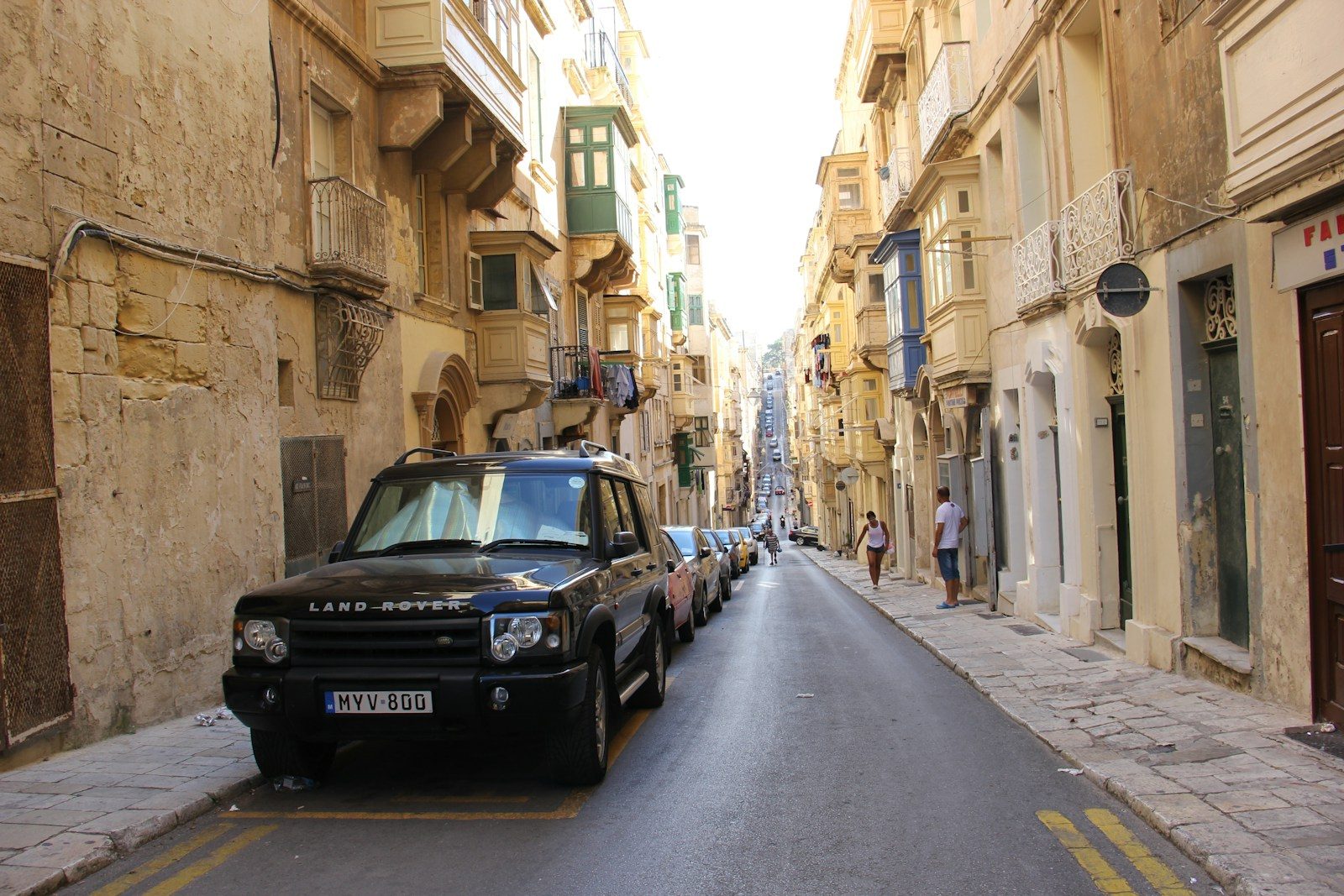

Malta looks easy to cross. On a map, the distance between a medieval town and a swimming cove can appear almost negligible. Once traffic, village streets and parking enter the equation, the same journey starts to feel very different.
That is not a reason to avoid driving. It is a reason to plan fewer stops. With four days, you can see Malta’s fortified cities, inland towns, prehistoric sites and western beaches without spending the holiday chasing map pins.
The first day requires no car at all. Valletta and the Three Cities are better approached on foot and by water. From the second morning, a compact rental becomes useful for the less connected parts of the island.
The Route at a Glance
| Day | Main stops | How to get around |
|---|---|---|
| Day 1 | Valletta and the Three Cities | Walking and harbour ferry |
| Day 2 | Mdina, Rabat, Mosta and Dingli Cliffs | Rental car |
| Day 3 | Ħaġar Qim, Blue Grotto and Marsaxlokk | Rental car |
| Day 4 | Golden Bay, Għajn Tuffieħa and Mellieħa | Rental car |
| Optional Day 5 | Victoria, Dwejra and Gozo | Car and vehicle ferry |
Where a Car Helps — and Where It Does Not
Malta has an extensive bus network. Travellers staying around Valletta, Sliema or St Julian’s can cover much of a short city break without driving.
A car earns its keep when the day combines places that do not sit neatly on one bus route. It also allows an early start for popular beaches and makes rural accommodation considerably more practical.
Hiring one is particularly useful for:
- combining inland towns with coastal stops;
- reaching archaeological sites in southern Malta;
- travelling with children or beach equipment;
- staying away from the main urban corridor;
- changing plans when wind affects a beach or boat trip;
- taking a vehicle to Gozo when the rental agreement permits it.
Central Valletta is the obvious exception. Its compact streets are walkable, parking is limited, and the Controlled Vehicular Access system monitors vehicles entering and leaving the charging area. A car parked all day near the capital offers little advantage.
Choosing the Rental Car
For two people with ordinary luggage, a compact car is usually enough. Extra width becomes noticeable in historic villages, older garages and narrow two-way streets.
An automatic can remove one distraction for drivers who are adjusting to left-hand traffic. Families may need a larger vehicle, but it is worth checking the actual boot capacity rather than relying on the advertised number of seats.
Compare the complete rental terms, not only the daily price:
- security deposit and accepted payment methods;
- insurance excess and exclusions;
- fuel return policy;
- daily or total mileage allowance;
- additional-driver charges;
- airport, hotel or late-arrival fees;
- permission to take the vehicle to Gozo;
- instructions for accidents, damage and breakdowns.
RentGo Malta lists selected rental options with a low deposit and without a mandatory conventional credit card. Some offers allow payment by debit card or cash. The conditions vary by vehicle and supplier, so confirm them before completing the reservation.
Deposit and excess are not interchangeable terms. The deposit is the amount held or collected at pickup. The excess is the amount the renter may remain responsible for if the vehicle is damaged under a covered incident.
Day 1: Valletta and the Three Cities
Start near Valletta’s City Gate and continue on foot. Republic Street contains many of the capital’s best-known buildings, but the quieter side roads reveal just as much: enclosed balconies, steep stairways and sudden views of the harbour.
St John’s Co-Cathedral deserves enough time to see the interior rather than treating it as a brief photo stop. From there, continue towards the Grand Master’s Palace area and the Upper Barrakka Gardens.
The gardens overlook the Grand Harbour and the fortified towns across the water. Instead of driving around the shoreline, cross by harbour ferry or traditional water taxi.
Birgu, also called Vittoriosa, has residential lanes, fortifications and a lively waterfront. Senglea offers another angle across the harbour, while Cospicua connects the two. The distances are manageable on foot, though comfortable shoes help on the slopes and stone streets.
Return to Valletta by water or stay in Birgu for dinner. If you are sleeping in the capital, collect the rental car the following morning rather than paying to keep it in a garage.
Day 2: Mdina, Rabat, Mosta and Dingli Cliffs
Reach Mdina early and park outside the walls. Vehicles have little place inside the old city, whose narrow streets lead between churches, palaces and quiet courtyards.
The bastions provide broad views across Malta. Early morning is calmer, while late afternoon brings softer light to the limestone buildings.
Rabat begins directly outside Mdina. Its streets feel busier and more lived-in, with cafés, churches, catacombs and archaeological sites. Leave the car where it is and explore both towns on foot. This is also an appropriate moment to stop for pastizzi rather than rushing towards the next destination.
After lunch, continue to Mosta. The town’s domed church rises above the surrounding streets and makes a natural stop between central Malta and the west coast.
Finish at Dingli Cliffs. There is no single platform that defines the area; the appeal lies in the exposed limestone landscape and open Mediterranean view.
Keep back from the cliff edge, especially during strong wind or fading light. Paths can be uneven, and barriers are not present along every section.
Order of stops
- Park outside Mdina and arrive before the main crowds.
- Walk through Mdina and Rabat.
- Stop in Mosta after lunch.
- Reach Dingli Cliffs in the late afternoon.
Day 3: Ħaġar Qim, Blue Grotto and Marsaxlokk
Day three follows the southern side of Malta from west to east. Begin at Ħaġar Qim and Mnajdra, two megalithic temple complexes set above an exposed stretch of coast.
Allow time for the visitor centre and the walk between the sites. There is little natural shade in the surrounding landscape, so carry water and sun protection during warmer months.
The next stop is the Blue Grotto viewpoint. From the elevated roadside area, you can look across the sea arch and cliffs below. Boat trips leave from Wied iż-Żurrieq when sea conditions are suitable.
Do not build the entire day around the boat. Wind and rough water can suspend departures even when the weather looks pleasant from land.
Continue east towards Marsaxlokk. Colourful traditional boats sit in the harbour, with restaurants and market stalls along the waterfront. Sunday brings a larger market and heavier crowds; weekdays are better suited to a quieter harbour walk.
St Peter’s Pool can be added when the weather is calm and enough daylight remains. It is a rocky swimming spot rather than a serviced beach. Access requires a walk, shade is limited, and the water should be avoided in rough conditions.
The temples, Blue Grotto area and Marsaxlokk already fill most of the day. Treat St Peter’s Pool as an option, not an obligation.
Day 4: Golden Bay, Għajn Tuffieħa and Mellieħa
Golden Bay has a sandy beach, road access and facilities nearby. It is one of the simpler places on the west coast for a longer swimming stop.
Għajn Tuffieħa lies close by but feels less developed. A long staircase leads to the beach. The descent is manageable for many visitors; the return climb is harder in midday heat.
Choose one of the two beaches for swimming rather than trying to divide the morning evenly. The other can be viewed from above or included as a shorter walk.
Continue north to Mellieħa. The old town occupies a hillside overlooking Mellieħa Bay, one of Malta’s largest sandy beaches. Its elevated streets provide a different perspective from the resort area below.
Anchor Bay makes a possible final stop. The film-set village occupies the cove, while viewpoints above the bay provide a look across its distinctive waterfront.
Traffic often becomes heavier later in the day, so leave some flexibility for the return journey.
Optional Day 5: Gozo by Car
Gozo deserves its own day. Vehicle ferries run between Ċirkewwa in northern Malta and Mġarr Harbour in Gozo, but permission to take a rental car aboard depends on the agreement.
Ask the supplier before travelling and confirm that the insurance remains valid in Gozo. Do not wait until the ferry terminal to check.
From Mġarr, drive towards Victoria and walk up to the Citadel. Continue west to Dwejra, where cliffs, rock formations and the inland sea shape one of Gozo’s most recognisable landscapes.
Use the rest of the day for one additional stop. Xlendi offers a compact coastal setting, Marsalforn has a larger waterfront, and the inland villages provide a quieter alternative.
- Take the vehicle ferry from Ċirkewwa.
- Visit Victoria and the Citadel.
- Drive to Dwejra.
- Select one village or swimming location.
- Return to Mġarr without relying on the final possible crossing.
Driving Habits That Need an Adjustment
Traffic keeps to the left
Vehicles travel on the left, and traffic moves clockwise around roundabouts. Drivers accustomed to the opposite system should be especially careful when leaving car parks and joining quiet roads.
Short journeys can still be slow
Congestion is common around Valletta, Sliema, St Julian’s and the main commuter routes. Avoid placing a timed attraction immediately after a journey with no margin for traffic.
Navigation apps do not judge road width
A suggested lane may be technically passable but uncomfortable in a rental car. Stay on the signed route when an alternative looks unnecessarily narrow.
Road surfaces are inconsistent
Conditions can change between a main road and a rural turn-off. Slow down before poorly visible edges, uneven surfaces and tight bends.
Motorcycles move through traffic
Check mirrors and blind spots before turning or changing lanes. Scooters may travel beside queues of slower vehicles in urban areas.
Understanding Malta’s Parking Markings
Use off-street parking or bays marked with white lines whenever possible. A single yellow line restricts waiting or parking during the times shown on nearby signs. Double yellow lines prohibit waiting at all times.
Other spaces may be reserved for residents, deliveries or drivers with disabilities. Signs and time plates take priority over assumptions based on colour alone.
Valletta’s Controlled Vehicular Access system records entry and exit using number-plate cameras. Charges are calculated according to the time spent within the controlled area. With a rental car, ask the supplier how CVA charges and any related administration fees are passed on to the driver.
Do not leave passports, money, luggage or electronics visible inside the vehicle. Take valuables with you even during a short viewpoint stop.
Driving Licence and Rental Requirements
Carry a valid driving licence, passport or identity card and the rental confirmation. Keep the agreement and vehicle documents available throughout the rental period.
Valid EU driving licences are recognised in Malta. Licences issued elsewhere may also be valid for a short visit, but the conditions depend on the issuing country. The rental supplier may request an International Driving Permit or translation when the original licence cannot be readily understood.
An International Driving Permit accompanies the original licence; it does not replace it.
Rental providers also set their own minimum age and driving-experience requirements. Legal permission to drive in Malta does not guarantee access to every vehicle category.
What Commonly Goes Wrong
Too many stops
Malta’s scale encourages ambitious plans. Parking and walking still take time, even when the next town is only a few kilometres away.
Driving into historic centres
Valletta, Mdina and the Three Cities reveal more on foot. Use an established car park rather than searching for a space beside every attraction.
Hiring a larger vehicle than necessary
Extra width becomes obvious on village streets and in older garages. Choose enough space for the group and luggage, not the largest affordable category.
Reading only the deposit amount
A low deposit does not describe the insurance cover. Review the excess, exclusions and damage procedure separately.
Assuming Gozo is automatically permitted
The ferry carries vehicles, but the rental agreement determines whether your particular car may travel.
Ignoring the wind
Sea conditions can affect boat trips and rocky swimming spots. Keep an inland alternative ready for days when the coast is unsuitable.
Frequently Asked Questions
Is renting a car in Malta worthwhile?
It helps when one day includes several towns, beaches or archaeological sites. A car is less useful during a trip focused on Valletta, Sliema or another well-connected urban area.
Is driving in Malta difficult?
The biggest adjustment for many visitors is left-hand traffic. Narrow streets and busy junctions require patience, but a compact vehicle and a realistic itinerary make the experience easier.
Can a car be rented without a credit card?
Some suppliers accept a debit card or cash and offer low-deposit vehicles. The available payment methods depend on the vehicle, dates and provider.
Can a Malta rental car be taken to Gozo?
Some agreements permit it, but approval is not automatic. Confirm that the supplier allows the ferry crossing and that the insurance remains valid in Gozo.
What type of car suits Malta?
A compact model works well for most couples and is easier to manoeuvre in villages and car parks. Families should balance passenger and luggage space against the added width of a larger vehicle.
How many days are needed for a Malta road trip?
Four days provide time for the main regions of Malta at a comfortable pace. Add another day for Gozo and more time if swimming, diving or archaeological sites are the main focus.
Is an International Driving Permit required?
That depends on the country that issued the licence and the supplier’s conditions. When required, the permit must be carried with the original driving licence.
Leave Room Between the Pins
Two historic towns and a coastal stop often make a better day than a route filled with hurried visits. Malta’s detail is found outside the car: inside a church, along a harbour or at the bottom of a limestone staircase.
Drive where it saves time, walk where streets become narrow and let the weather decide whether the final stop should be a beach or another old town.